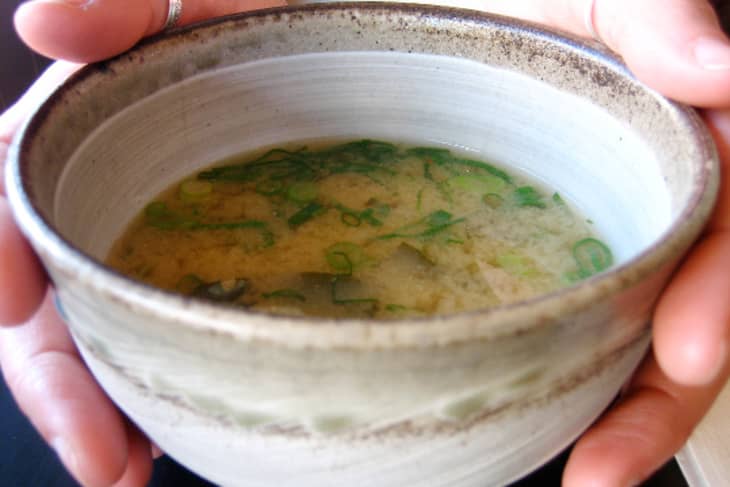
More and more of us are discovering what a fantastic ingredient concentrated miso paste can be in our daily cooking - and not just for soup! Happily, many major stores have caught on and are starting to carry a variety of traditional misos to choose from. The real question is: how to choose? Read on...
To be completely honest with you, we found a lot of conflicting information about the different types of miso and how they're actually different. Below is a summary of what we understand about the most common types of miso now found on the market in the United States - but if you're a miso expert, please chime in and educate us!
White Miso: This miso is made from soybeans that have been fermented with a large percentage of rice. The actual resulting color can range from white to light beige, and the miso has a definite sweet taste. It's best used in condiments like mayo or salad dressings, or in light sauces.
Yellow Miso: Yellow miso is usually made from soybeans that have been fermented with barley and sometimes a small percentage of rice. It can be yellow to light brown in color. This miso has a mild, earthy flavor and is better for general use in not only condiments, but soup, marinades, and glazes.
Red Miso: This is also typically made from soybeans fermented with barley or other grains, though with a higher percentage of soybeans and/or a longer fermentation period. It can range in color from red to dark brown. The deep umami flavor of red miso can overwhelm mild dishes, but is perfect for hearty soups, braises, and glazes.
Black Miso: Our information on black miso isn't entirely clear. Some sources say this paste is made entirely from soybeans, others say that it's made from soybeans fermented with hearty dark grains like buckwheat. Regardless, this sounds like the strongest flavored miso around (the descriptions remind us a bit of marmite!).
The depth of color with any particular miso can also tell you something about it's flavor. Generally speaking, the darker the color, the longer it's been fermented and the stronger it will taste. Both yellow and red misos can sometimes be labeled "barley miso," so check the actual color of the paste for an indication of how mild or strong it is.
What kind of miso do you generally cook with?
Related: Recipe Review: Green Beans with Walnut Miso Sauce
(Image: Flickr member adactio licensed under Creative Commons)
Elizabeth Apron fro...

I'm guessing yellow is what I end up w/ from the international market. Does anyone have tips for adding Miso to soup? I've been mixing a little in a bowl with water before adding a serving of soup... wonder if adding to the pot on the stove makes it better or not.
Deftgirl - in our recipe for Ginger Miso Soup, we suggest placing the miso in a small bowl and adding a small amount of the soup's broth and mixing those together before adding it back to the soup. I'm not sure if that's the technique you were talking about above, but hopefully that should help.
Also, as far as using miso beyond just soup, check out this recipe for "A href="http://www.kitchencaravan.com/recipe/soba-noodles-tofu-miso-dressing"> Soba Noodles with Tofu Miso Dressing - it's delicious, energizing and makes for a perfect lighter meal.
sorry guys - I totally messed up that link for the Soba Noodles - this should work.
Deftgirl- If you add the miso to the pot after mixing it with a small amount of broth, don't boil it. I don't remember where I heard it, but boiling miso makes it bitter or something and ruins the flavor. Plus you won't get that "bloom" when you stir it around.
I buy yellow miso because it seems to be the most versatile and I don't use it very frequently. Though I should expand using it beyond soup... I love miso dressings in restaurants and stuff, but never get around to trying it at home.
Hartley and 2T - Thanks so much for the tips! I have never added to soup pot after mixing, but from what you are saying, i can as long as I don't boil again, so that will save me some time! also, that Soba Noodles recipe sounds great, I'll add it to my to-try list.
I've had much success with a miso salad dressing recipe from Moosewood. Everyone I've subjected to it raves and it keeps forever in the fridge. :)
Wow Emma, can't thank you enough for this information. I have been looking for ways to spice up my dishes by using exotic condiments. Have a great one!
No- you don't want to boil miso because it is a live food, like yogurt. It's a fermented product. Boiling kills the useful bacteria.
Thanks for helping to unravel the mysteries of miso. I just recently randomly purchased some yellow miso (unsure of which color would be best) and had amazing results using it in this chicken soup:
http://www.izzyeats.com/2009/02/chicken-soup-with-miso-secret-stock.html
Here's what I learned from Japanese resources;
It's the different level of maillard reaction (never heard of it!), or browning reaction, that decides Red or White, for which the length of aging is the major factor. The method of cooking soy beans (red:steam, white:boil) or the type and quantity of Koji (the fermenting agent), etc also matter.
Red: longer aging (over 1 yr), more brown, salty and rich. White: shorter aging (a few months), sweet and light. Yellow in between.
Black, yea just soy beans and the way they use Koji is different. About 2 years of aging.
Yes, it is common understanding in Japan never bring the soup to boil after adding miso to keep the aroma and the tender taste of miso. Some noodle(Udon) recipes often with Black miso prefer simmering though.
To put miso into the soup, it is also popular to use a tool like this http://www.amazon.co.jp/dp/B0001BDD20 It goes directly into the soup in the pan. Otherwise you just keep the miso in a ladle until it becomes completely creamy while mixing with soup and releasing it little by little.
Now I learned a lot about Miso myself. Thank you!
I just came here to recommend a miso strainer, if anyone frequently makes miso soup -- miayo beat me to it but I'll throw my $.02 in anyway. It's a regular dinner item in my apartment, and I was SO sick of patiently mixing the miso in. Not that mixing the miso takes so much time or effort, but I usually make quick dinners and mixing miso would take valuable time away from other dishes.
I usually avoid single-use kitchen products, but this one is well worth the small amount of space it takes up -- I use it so often that I just keep it hanging on the wall near the stove. Muji sells one, for anyone who lives in NY, but I'm sure you can buy them in lots of Japanese home goods stores. They look like big tea strainers, usually.
I buy both white and yellow miso. Does anyone know the shelf life of a package of miso? I've heard different things, from 3 months to 6 months to one year.
This is just the information I've been looking for! Thanks for being a resource. I guess I need to try each kind out though, since they sound differently flavored enough.