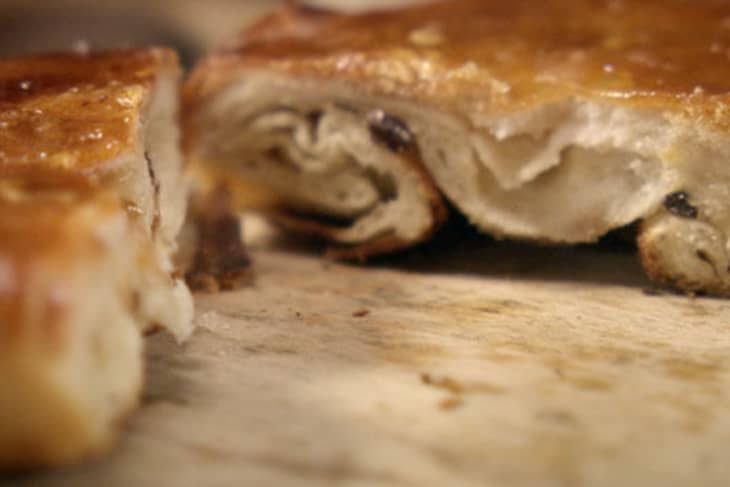
Lardy Cake. Just the name alone will cause some people to faint in horror as lard still has a bad reputation with many health-conscious eaters. But denizens of Great Britain might also smile a little, too, for Lardy Cakes are a traditional tea time treat and many Brits I know have a soft spot for this sweet, doughy, crunchy treat. And perhaps it will come back into good graces as we are rediscovering lard as a healthier fat.
For centuries lard was the fat of choice in most 'peasant' cuisines as it was cheap and readily available. Plus, it's delicious. In modern times, however, as manual labor declined and heart and weight problems increased, lard was banned from many diets. It's only in recent years that we've rediscovered lard and that it is, relatively speaking, a healthier fat than most.
By weight, lard has less saturated fat, more unsaturated fat, and less cholesterol than an equal amount of butter. Unhydrogenated lard also contains no trans fat making it superior to margarine and vegetable shortening which, ironically, were often used as substitutions for lard. So slowly lard is making its way back into our good graces.
As an American, the Lardy Cake doesn't have a cultural resonance with me but that doesn't mean my belly didn't rumble a little when I saw this Lardy Cake recipe. The idea here is to make a yeast dough with a little bit of lard, then fold it around a scattering of currants and raisins. A mixture of lard and sugar in dolloped into pans followed by the dough and then it's baked. The lard/sugar melts into a caramel-like crust which when cooled becomes super crisp. When you take a bite, the crispy crust shatters in your mouth, followed by the chewy pastry. Yum.
While lard may be better for us than butter, this doesn't give us carte blanche to wolf down a stack of lardy cakes. It's a pastry after all, high in fat and sugar, and so would be an occasional treat, at least in my household. The recipe linked to below makes three Lardy Cakes but calls for over a pound of lard which, since many of us make our livings sitting at a computer and not in the coal mines, is a lot of calories to burn. (The recipe doesn't indicate how many people one Lardy Cake serves.)
The Fabulous Baker Brothers, a British food program about two brothers, one a butcher and chef and the other a baker, made Lardy Cakes on the last episode of their new TV cooking show. Sadly, folks outside of the UK can't watch the clip, but here is their recipe and method.
What do you think about lard these days? Is it still something you avoid or are you loosening up a bit? Have you ever had or made a Lardy Cake? If so, how does this recipe compare to yours?
Related: Lear How to Make Cornish Pasties in an Eclectic Manor House Kitchen
(Image: The Fabulous Baker Brothers on Channel 4)

Comments (14)
I love pasties and I am really interested in making this lardy pie recipe (I've never heard of it) but I find it annoying that you embedded an episode that has nothing to do with the article. I know you put a disclaimer but why even include it at all?
Actually, margarines are available that are both free of trans fat and much lower in saturated fat than lard, making them healthier (e.g., Earth Balance).
Lard? Yuck. There's no reason to use lard when there are healthy, tasty, and cheap alternatives.
Sounds yummy and better for you than butter, I'll give it a try but where would I get lard?
The concept sounds similar to waffles Liège; chewy yeasty inside, crusty caramel-y outside. And waffles Liège are made with butter and egg yolk.
I don't eat lard, ever, because I'm a vegetarian. But @bluepuppybites, check the Goya aisle or a Spanish food store. A can of manteca is lard.
I have had uniformly bad results baking with Earth Balance. If I don't want to use butter, I go with unhydrogenated shortening.
Not sure about making something with that much lard in it, but definitely, research is now showing that fats which have been eschewed for margarine are actually much healthier for us -- butter, lard, goose/duck fat, coconut oil, etc. We don't eat much pastry, period, but when we do, we use butter or lard, and never shortening.
I haven't baked or made anything with margarine or vegetable shortening in over 20 years, and doubt that I ever will.
@bluepuppybites, you can find shelf-stable lard in Latin groceries and most well-stocked grocery stores, but it's most likely partially hydrogenated, aka no better than margarine. Try to find a good butcher and ask for leaf lard, which is the delicious stuff around the kidneys of the pig.
Oh lordy I love the lardy! But not too much ... it's a treat to have a pastry. Earth Balance? Nooooooooo. Ick!
Margarine is made with chemicals. Lard is a natural product. That in and of itself means I'd use lard in favour of ANY kind of margarine. That being said, lard is not something we should be eating huge quantities of, given our society's sedentary lifestyle. Everything in moderation, blah blah blah. ;)
Please, please, please if you make this make sure to tell people that it contains lard. Vegetarians and people who keep kosher will thank you. Since most pastries don't contain meat products, people may not think to ask.
If you can find the uncommon "free-range" lard, you will have a healthier fat than our modern "corn-fed" standard. Free-range lard should be much higher in ALA and Omega-3s.
Then you can use the letftover lard to season your cast iron http://sherylcanter.com/wordpress/2010/01/a-science-based-technique-for-seasoning-cast-iron/
Beyond Margarine
It's no longer a secret that the margarine Americans have been spreading on their toast, and the hydrogenated fats they eat in commercial baked goods like cookies and crackers, is the chief culprit in our current plague of cancer and heart disease.22 But mainline nutrition writers continue to denigrate butter--recommending new fangled tub spreads instead.23 These may not contain hydrogenated fats but they are composed of highly processed rancid vegetable oils, soy protein isolate and a host of additives. A glitzy cookbook called Butter Busters promotes butter buds, made from maltodextrin, a carbohydrate derived from corn, along with dozens of other highly processed so-called low-fat commercial products.
Who benefits from the propaganda blitz against butter? The list is a long one and includes orthodox medicine, hospitals, the drug companies and food processors. But the chief beneficiary is the large corporate farm and the cartels that buy their products--chiefly cotton, corn and soy--America's three main crops, which are usually grown as monocultures on large farms, requiring extensive use of artificial fertilizers and pesticides. All three--soy, cotton and corn--can be used to make both margarine and the new designer spreads. In order to make these products acceptable to the up-scale consumer, food processors and agribusiness see to it that they are promoted as health foods. We are fools to believe them.
that was from sally fallon website
Margarine processing uses the cheapest seeds, most of which are full of pesticides and genetically engineered. Oil is extracted under high temperature and pressure, and the remaining fraction of oil is removed with hexane solvents. Then manufacturers steam clean the oils, which removes all the vitamins and all the antioxidants – but, of course, the solvents and the pesticides remain. These oils are mixed with a nickle catalyst and then put into a huge high-pressure, high-temperature reactor. What comes out of that reactor is a smelly mass resembling grey cottage cheese. Then they mix in the emulsifiers to smooth it out, and steam clean it again to get rid of the horrible smell. Then they bleach it to get rid of the grey color, and they add artificial flavors and synthetic vitamins. But they are not allowed to add a synthetic color to margarine. They have to add a natural color, such as annatto – a comforting thought. It is then packaged in blocks and tubs and advertised as health food.