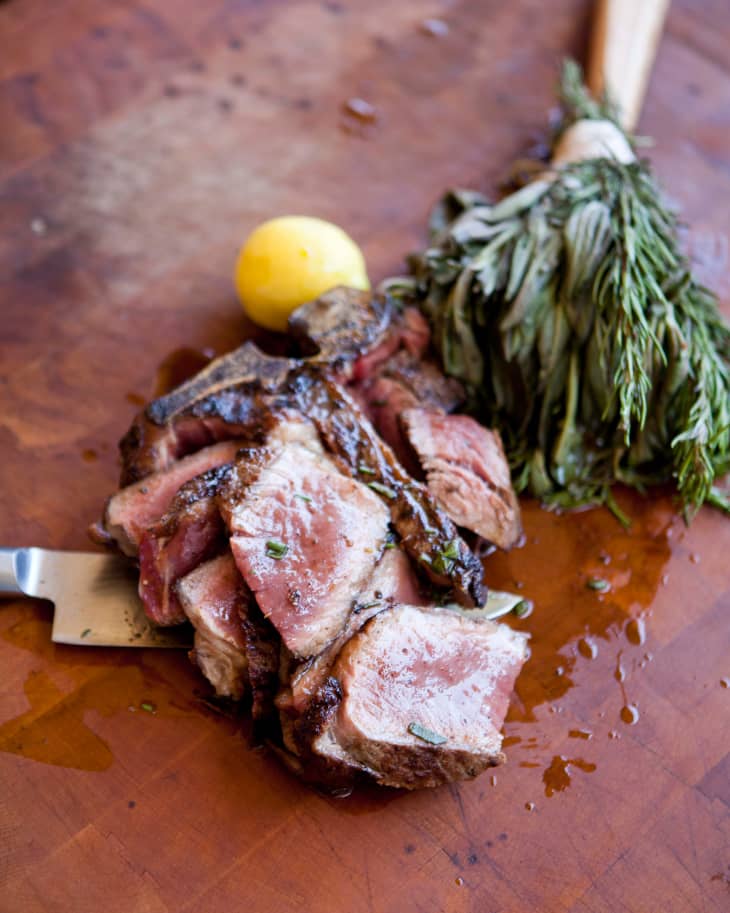
When grilling meat, styles may vary but one thing remains constant: everyone wants that perfect rich, brown crust with a juicy, evenly cooked center. So how do you do it? According to one notable chef, the key is to flip the meat constantly...
...or so says Adam Perry Lang, author of the new cookbook Charred and Scruffed:
Bold New Techniques for Explosive Flavor On and Off the Grill. in a recent NPR Splendid Table episode, he calls it having "a dialogue with heat." Lang, a classically trained chef, cooked for top New York and French restaurants before turning to grilling, where he quite unexpectedly started winning major barbeque competitions with his unusual methods. His secrets are outlined in his cookbook, but he shared a few tips on the podcast:
1. Do a "Hot Potato." Lang calls himself an extrovert at the grill—he likes to move around, talk, stay active—and this translates to his grilling style. But it's not just a personal preference; it's also the best way to grill a perfect piece of meat. His technique involves constantly flipping the meat while layering flavor with an herb brush and basting sauce, which helps develop the crust. This method also tempers the heat so that the meat cooks evenly.
2. Season 10 Minutes Early with a Paste. The key to a beautiful crust is seasoning with a paste before grilling. Seasoning on the grill or barbeque, as Lang says, is very different than a pan or oven. When you flip on the grill, the seasoning peels off onto the grill and comes away from the meat. Lang recommends seasoning ahead, ideally with a salt-based seasoning meat "paste," to allow time for the paste to create a glaze on the outside of the meat.
3. Don't Be Afraid of Scruffing. Scruffing—when meat sticks and tears on a hot grill—is actually desireable, according to Lang. "Most people are so attracted to grill marks. To me, grill marks happen but they're not the goal," Lang says. "I want to create surface area, as much browning as possible." Scruffing essentially creates a 3D cooking surface that enables you to build up layers of flavor.
Listen to the full Splendid Table podcast below - the Adam Perry Lang segment is right at the beginning!
Related: How To Grill Really Juicy Burgers
(Image: Mike Vrobel of DadCooksDinner)

Bacsac Bacsquare 04...

Interesting...I'd always heard that it was best to minimize the manipulation of the meat. Slap it on, turn 90 degrees for grill marks, flip, turn 90 degrees again.
Hmmm... I'd always been lead to believe that you shouldn't flip the meat too often, to keep the juices in, and that if you're shifting it about the grill a lot, it probably means your grill is too hot or you're just too impatient!!
Next week there'll be an article saying how we should leave the meat alone on the grill!
I definitely question the idea to keep flipping. It goes against everything I've ever learned about properly cooking meat, especially on a grill. Don't think I'll be taking Mr. Langs' word for it today....
actually makes a lot of sense. sort of like a rotisserie.
Heston Blumenthal has been recommending cooks turn the meat every 15 seconds. Refer to the steak episode 'How to cook like Heston' .
Apparently only flipping once results in the steak going cold on one side and an uneven layer of rare v well done. "Flipping the steak allows more even heat to gently radiate through the meat but, funnily enough, it doesn't take any longer to cook" according to Blumenthal.
wow. I know someone who is impatient and cooks a steak on his bbq like a diner cook would cook a burger on a flat top grill. They are always over done and well crap.
The bbq has a lid for a reason. You keep opening it up and flipping the meat you keep hijacking the temperature.
Agreed with everyone about not messing with the meat. Opening the grill messes with the temp and will take so long to cook all the juices get seared away. That said, I'm sure flipping every fifteen seconds is sound advice if you use an open hibachi type grill.
Most grillers I talk to are so set in their ways that they don’t even want to understand the basics of how the meat is being cooked.
To the above comments: Opening the grill does NOT mess with the temperature. It doesn’t matter if your grill is even burning at 3000 degrees because they’re actually designed to cook via radiant heat (the glow) and not convection. A key principle for grilling is that the actual burn temp is much less important than how much radiant heat is generated. Having the lid on or off simply does not change the amount of radiant heat produced.
(FYI -This also brings up an advantage of Charcoal which can produce more than twice the radiant heat of Gas)
This guy is just wrong. But, I'm sure there are people who will believe anything.
BREEZIE is right, you don't via convection on a grill. At least not when you're cooking a steak over direct heat. If you're cooking veggies, fish or poultry over indirect heat, then sure, convection will play a part due to the longer cooking times. However, the overwhelming majority of heat comes from the fire and grates when cooking steak, so open vs. close doesn't matter. In fact, I don't even close my grill when cooking steaks. I'd rather be able to keep an eye on them.
Another misconception here; simply turning a steak over does not result in lost juices. If you keep poking it with your grill fork, then yes. If you use tongs, juices don't magically escape into the air simply by turning the steak over. By that logic, a rotisserie chicken would come out dessicated every time...I mean, they NEVER stop turning.
I posted this elsewhere but I can't recommend this article enough...and some of the tips are similar to the one above. Flipping and poking will not ruin your meat.
Here's the article in a nutshell:
Start with the right cut (I prefer ribeye).
Check for marbling (you want plenty of intramuscular fat).
Buy a thick steak (at least 1 1/2 to 2 inches).
Bone in or boneless, it doesn't make a difference—this is totally a matter of personal choice (I prefer bone-in).
Get dry aged beef (unless you don't enjoy the extra tenderness or slightly funky flavor of dry-aged meat).
Salt in advance and salt well (I season mine four days in advance, but you want to go at a minimum of 40 minutes).
Use hardwood coal if you've got it, but briquettes will work just fine.
Cook your meat gently, then sear at the end (this'll give you more evenly cooked meat and a better crust).
Flip your meat as often as you like (the whole thing about only flipping once is utter nonsense, and we can prove it).
Use a thermometer if you have one, but if not, go ahead and poke or cut-and-peek (it won't adversely harm the end product).
Let your meat rest (your meat should rest for about 1/3 of the time it took to cook in order to prevent excess moisture loss).
But don't take my word for it...try it yourself. The last two steaks I cooked this way (on gas mind you) were up there for the two best steaks I've ever made. My wife was shocked that I had only seasoned it with salt. I didn't age but I salted with kosher salt at least 40 minutes before cooking both times.
http://www.seriouseats.com/2012/05/how-to-grill-a-steak-guide-food-lab.html