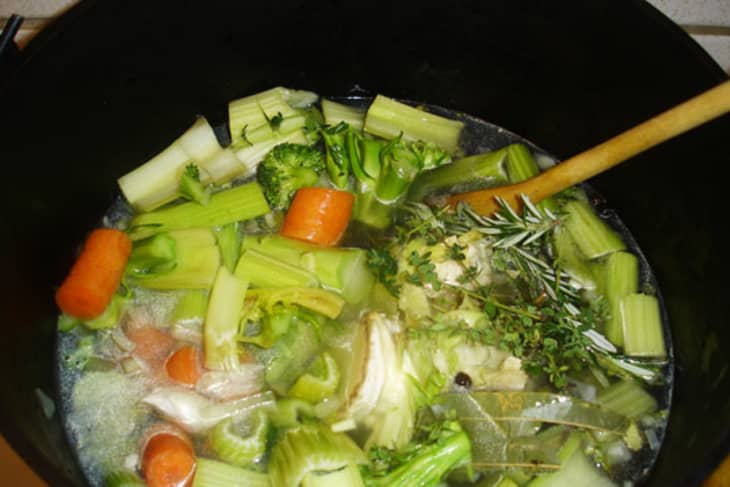
Vegetable stock is one of those ingredients that is easy to buy off the shelf yet so much more delicious – and economical – when cooked from scratch. And you don't have to purchase pounds of fresh veggies to make it.
Using vegetable peelings, stalks, and leaves can be a great way to save money and avoid wasting food. Here are some tips for saving vegetable scraps, which can be used in our basic D.I.Y. Vegetable Stock recipe.
• Vegetables to use: Onions, carrots, and celery are the key ingredients in vegetable stock, but many other vegetables can add depth and flavor. Wash and save roots, stalks, leaves, ends, and peelings from vegetables such as leeks, scallions, garlic, fennel, chard, lettuce, potatoes, parsnips, green beans, squash, bell peppers, eggplant, mushrooms, and asparagus. Corn cobs, winter squash skins, beet greens, and herbs like parsley and cilantro are also good additions.
• Vegetables to avoid: Scraps from the following vegetables are better off going into the compost bin, as their flavors can be too overpowering: cabbage, Brussels sprouts, broccoli, cauliflower, turnips, rutabagas, artichokes. Beet roots and onion skins should also be avoided, unless you don't mind your stock turning red or brown.
• Spoiled vegetables: Although stock is a great way to use veggies that are wilted or slightly past their prime, be sure not to use produce that is rotten or moldy.
• Storing scraps: You will want to collect about 4 cups of vegetables to make 2 quarts of stock. Save scraps throughout the week, wash and chop them into similar sizes, and keep them in an airtight bag or container in the refrigerator. If you are collecting scraps for longer than a week, store them in the freezer.
Do you have any other tips to share?
Related:
Recipe: D.I.Y. Vegetable Stock
How To: Make Chicken Stock
Good Tip: Stock in the Slow Cooker
Weeknight Meal Tip: Frozen Homemade Stock Portions
(Image: Flickr member chrisfreeland2002 licensed under Creative Commons)
Why didn't I ever think of this? Brilliant!
view jarobinson1's profile
I collect most neutral vegetable trimmings and store them in a bag in the freezer. When I have enough trimmings accumulated, I just throw them in the slow cooker with water and let them cook over night (or longer, if necessary). As for storing the stock, I freeze it in ice-cube trays and them pop the cubes into a bag. That way I can always add as little or as much stock to a dish as I need.
view bubble's profile
I will definitely start a freezer bag for scraps!
I always feel guilty throwing the scraps out since we don't have a compost.
I always have a use for stock!
view revolution9's profile
I like to throw 2 or 3 whole peppercorns into the mix for added flavor. And I always use onion skins--I actually like the deep, rich color they give a veggie stock. (It can get quite dark though. My Polish mother-in-law used to use the water from boiled onion skins to dye Easter eggs when she was a kid!)
Thanks for the reminder--I'm making stock right now!
view nora's profile
I do this religiously. This is going to change your life, people!
view FromTheFuture's profile
I do this too; I can't believe I used to *buy* veggie stock back in the day! In addition to the peppercorns I add a couple of bay leaves, garlic, some dried herbs, and I'm good to go!
view stolichnaya's profile
I just made a massive pot of lentil soup and had a lot of veg scraps that went into the compost heap. NEVER AGAIN!
view Amandica's profile
I tried this about a year ago at my sister's house while we were on a cooking streak. It started out smelling like chamomile tea (which I like) but ended up smelling funk. We affectionately named it 'dirt soup' as we poured it down the drain.
I don't remember the details -- maybe we added one of the things we shouldn't. I'll certainly try again with this advice in mind.
Thanks, Emily!
view jeffzelli's profile
I've been doing this since my first round of poor college student days, and it's a real money saver. I always keep a big rubbermaid pitcher that *only* is used to hold stock, and a produce bag (no, I don't even bother to keep it sealed) in the freezer. When I run out of stock, I I grab the produce bag from the freezer and make a gallon or so. I do actually include everything from the list you have of vegetables to avoid in my produce bag, and I've never noticed an overpowering stock - just a darker coloured one with a richer, more complex flavour. I've never cut them into similarly sized pieces, either. I just chunk them in the bag, dump them in a pot or crock pot and cook with water overnight.
view seidhr's profile
Two things I've found:
One: Avoid overcooking it. Though you want to simmer it long enough to extract all the sweet, sweet flavors, cook it too long and it ends up bitter. Which is gross.
Two: Always taste the stock before using it. Every so often, a stock will end up tasting bitter (see above) or just particularly strong. This flavor will transfer over into your soup/etc, so make sure you want that flavor before using. That said, I frequently freeze my extra stock and stick a masking tape note to the top of the container that lists the date made and the predominant flavors. That way I can pick and choose according to my intended dish.
Also, I've found that rosemary makes my stock quite bitter, though I have friends who swear by its flavor. Any thoughts?
view katiebug's profile
katiebug, maybe add the rosemary in toward the end of simmering.
view jamiealyse's profile
I've done this for years, and always include onion skins. I love the color they bring. And yes, I agree with katiebug, I do find that too much rosemary makes the stock bitter, but a small amount is okay (and overcooking=bad!). In general, certain items make it bitter, others are safe.
view violet222's profile