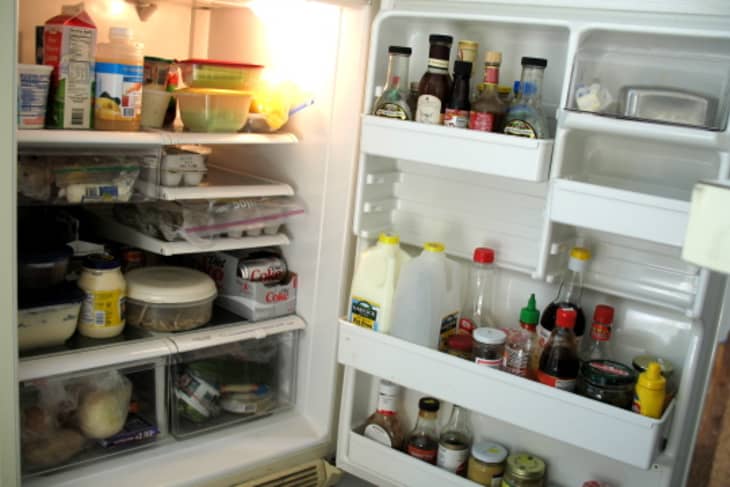
Major storms tore through the eastern half of the United States on Friday, and millions of people went without electricity all weekend. Were you one of them? If so, do you have power back now, or are you getting cool and catching up with your blog reading at a cafe or the office? Between these freak storms and hurricane season, it seemed like a good time to reacquaint ourselves with basic fridge safety protocol. Here is what you should know, in case your fridge and freezer lose their juice.
Refrigerator Safety: The Essentials
Here are the basics of fridge safety, from the Centers for Disease Control and Prevention:
If the power is out for less than 2 hours, then the food in your refrigerator and freezer will be safe to consume. While the power is out, keep the refrigerator and freezer doors closed as much as possible to keep food cold for longer.
If the power is out for longer than 2 hours, follow the guidelines below:
• For the Freezer section: A freezer that is half full will hold food safely for up to 24 hours. A full freezer will hold food safely for 48 hours. Do not open the freezer door if you can avoid it.
• For the Refrigerated section: Pack milk, other dairy products, meat, fish, eggs, gravy, and spoilable leftovers into a cooler surrounded by ice. Inexpensive Styrofoam coolers are fine for this purpose.
• Use a food thermometer to check the temperature of your food right before you cook or eat it. Throw away any food that has a temperature of more than 40 degrees Fahrenheit.
The magic number there? 2 hours. Yep, after two hours, either transfer the stuff in your fridge to a cooler or a working refrigerator. Don't mess with spoiled food; it's not worth getting sick.
What To Throw Away and What To Keep
OK, so your fridge has been without power and above 40°F for more than 2 hours. Is anything safe to keep?
Yes, some condiments and foods are OK to keep, although meat and most dairy need to go. Here's a very helpful and handy list from FoodSafety.gov on what to keep and what to toss:
Refrigerated Food and Power Outages: When to Save and When to Throw Out at FoodSafety.gov
More resources for fridge safety and disaster preparedness:
• Keeping Food Safe During an Emergency - USDA
• Are Any Condiments Safe to Keep After a Power Outage?
• Cooking in a Hurricane? 5 Tips for Staying Safe & Well-Fed
• Hurricane Irene and What We Ate: Observations from NYC
What about you? Did you lose power, or did you escape the storm?
(Image: Emma Christensen)
Bacsac Bacsquare 04...

I would LOVE to see someone do a salvage article on traditional techniques of preservation in the event of a power outage. For example: turn that milk into yogurt, cook (or not) and smoke or brine the raw meat (if completely submerged, while it does need to stay cool - refrigeration is unnecessary), pickle the delicate veggies and look at that "don't refrigerate your plant food" sheet that the kitchn has posted a couple of times. Certainly the cooler method may work better for many people, but it would be neat to have a guideline of alternatives!
Oh yes, and sun-based dehydration. If you were going to throw it out anyway, why not try an experiment!
Agree with Tatterh00d -- I kefir'd all my milk and shrub'd all my berries (controlled spoilage!), but other ideas would have been welcome! We still had gas, so oven/stove things might have been an option for some people, though the idea of lighting fires in the already-oppressive heat was a bit daunting.
I'm also not completely sold on foodsafety's "this should be discarded" list, but better safe than sorry. I'll take responsibility for any illness resulting from my few-days-without-refrigeration greens and veggies (moved to the basement garage, some with damp cloths). It was a good reminder, though, that my tofu should probably go out.
I have to say, I find this ludicrously conservative. Two hours at 40 degrees and you have to throw away a cooked chicken? A gallon of milk? Soft cheeses? Cooked eggs! Eggs in Europe aren't even refrigerated, and cooking meat, milk, vegetables and eggs is a way to slow down bacterial degradation: short-term preservation, if you will. Cheese was invented as a way to preserve milk before modern refrigeration, and I've certainly had parties where soft cheeses sit out at room temperature, let alone 40 degrees, for more than 2 hours.
I'm all for food safety, but this is ridiculous.
Yeah, this is a little nuts, but I am with TATTERH00D: a list of things to do with fridge items that are about to go bad (power or no) would be a lot more helpful.
Don't forget that you can claim the spoiled contents of a fridge from a power outage on your homeowner's insurance. I probably wouldn't do it unless you had other storm losses, as it will raise your rates anytime you have a claim, but think about how much it cost you to buy all those condiments, butter, etc.
Try living on a remote windswept island in the PNW where frequent 2 and 3 day power outages for the whole island are the norm in winter. If we had to throw everything out after 2 hours everytime it happened...
Totally think it would be cool for a guide a-la TATTERH00D.
When I moved to Florida in 2004, I was onslaughted for two and half years by big hurricane seasons. Learned a GREAT lesson. Ice cubes do nothing but melt, but if you can get three or four orange juice cartons or something large to freeze, and keep all year round as a 'block' of ice, when the electricity goes out, those suckers lasted me weeks in the freezer.
Now I live in Abu Dhabi, where if you lose electricity for a couple days (not because of a disaster, but because of crappy electical wiring or something), I just throw everything into the freezer and those blocks of Al Ain water, frozen, last the whole time.
Same goes for camping here. A block of a water-filled frozen carton will last 5x as long as a bag of ice cubes twice the size.
That's my recommendation - keep blocks of ice all year round. :)
Mackheath1 - I learned that lesson from my boyfriend, who did archaeology in Death Valley last summer. They kept a rotating stock of gallon jugs of water in the freezer. They used them in the field to keep food cool, and drank the water as they melted! We now keep several in our chest freezer!
thanks MACKHEATH I'll be using that tip since it always takes at least 3 days for electricity to be restored after a major storm.
Yes..THANK YOU MACKHEATH..so easy to do and total 'lifesaver'..I will do that in anticipation of hurricane weather..(that we never get ...MA, really).. but I will keep those wonder blocks in my freezer year round..simple and saves whatevvvver may be in there...single..doesn't cook..really..I will def pass your tip on..to everyone!
Claiming your spoilage on your homeowner's insurance policy is a nice thought, but it's usually a dead end. Unless you had your fridge stocked with very expensive cuts of meat and other items for a large dinner party, the financial tally is rarely going to top your deductible. So it's a wash -- no matter how many bottles of salad dressing, Irish butter and stir-fry condiments you have. Plus you need to have receipts (listing everything, not just a notation on your credit-card statement) to prove what you had.