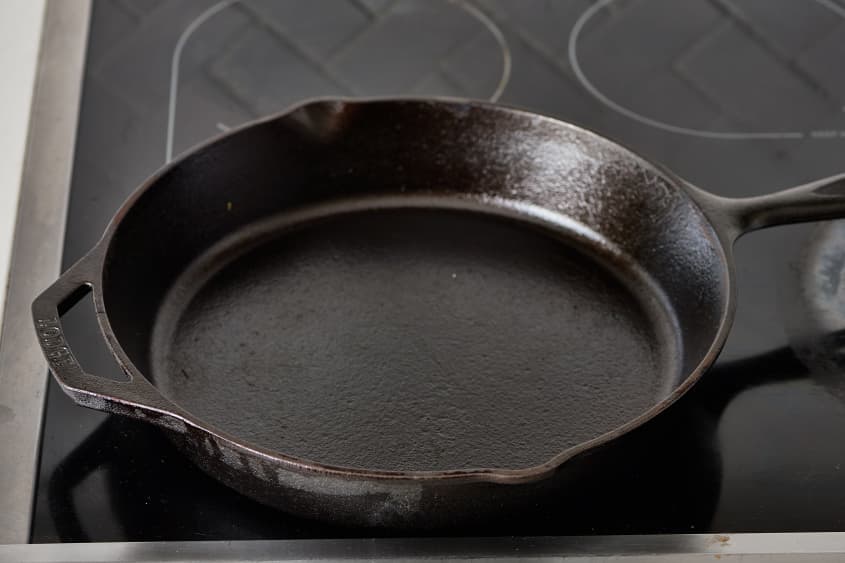
Properly maintained, a cast iron skillet can last a lifetime. We've covered the science and method of cast iron seasoning before, but we thought we'd revisit this essential technique for anyone who's new to cast iron or simply needs a refresher.
What You Need
Materials
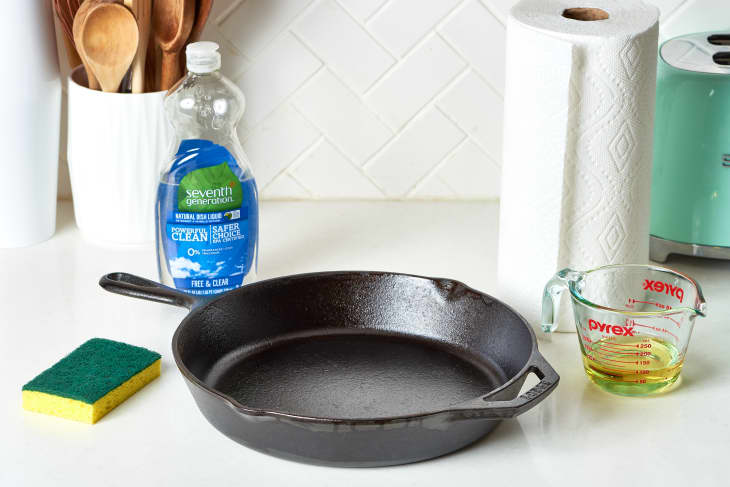
Cast iron skillet
Dish soap
Sponge or stiff brush
Clean, dry cloth or paper towels
Vegetable oil or shortening
Equipment
Oven
Instructions
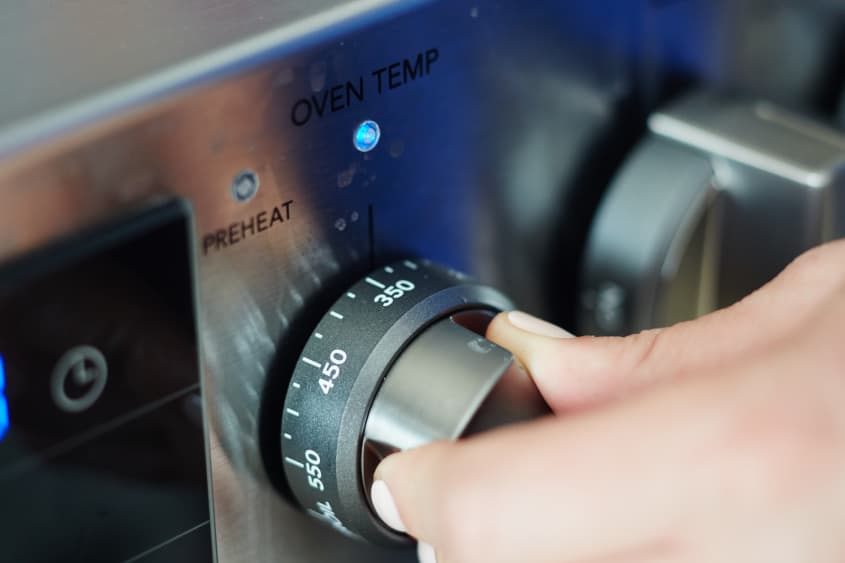
1. Preheat oven to 325°F.
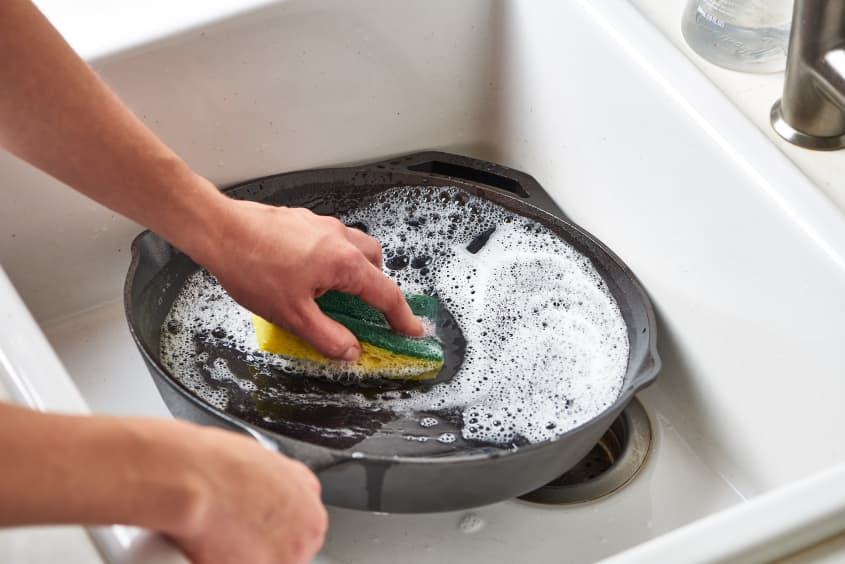
2. Wash the skillet with warm, soapy water and a sponge or stiff brush. (Cast iron should not normally be washed with soap, but it's fine here since the pan is about to be seasoned.)
3. Rinse and thoroughly dry the skillet.
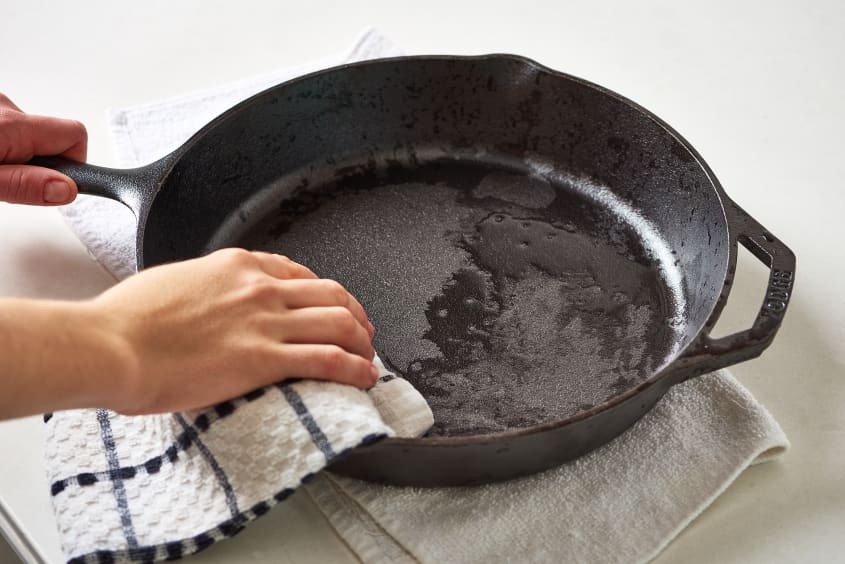
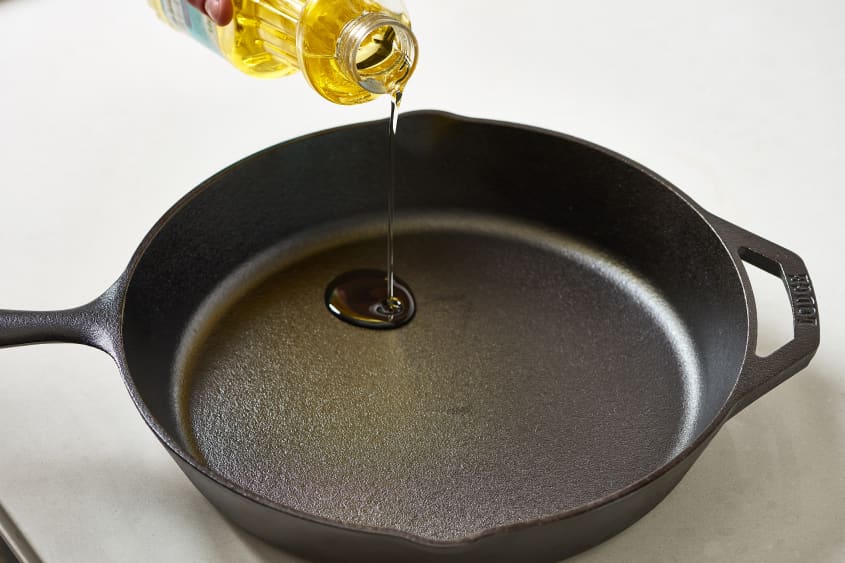
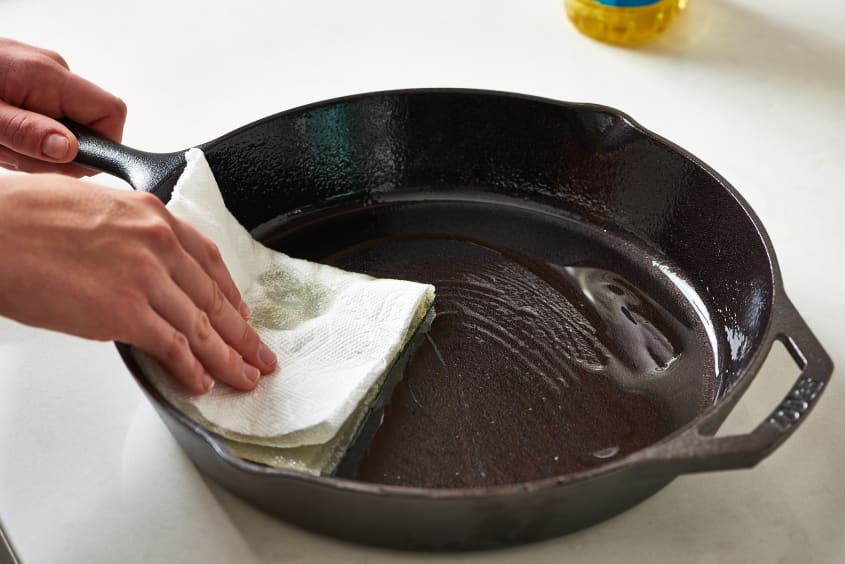
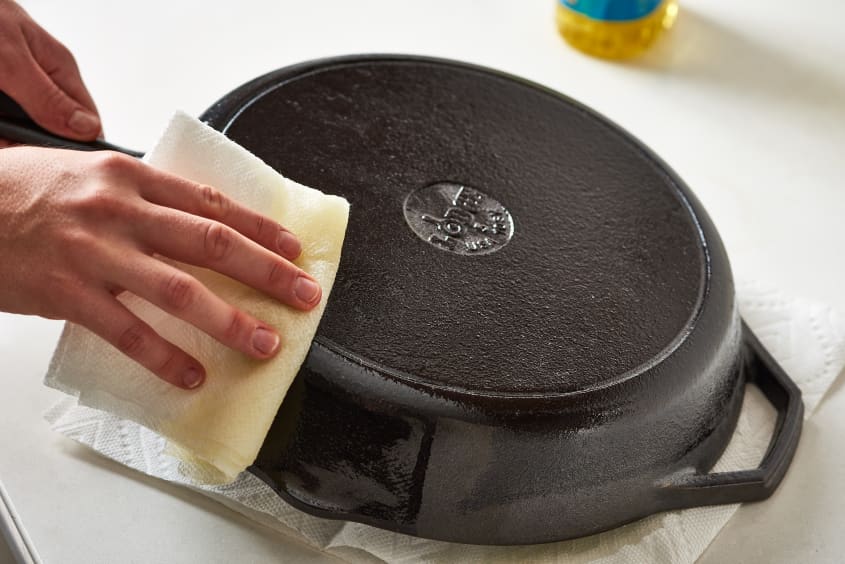
4. Using a cloth or paper towel, apply a thin coat of vegetable oil or melted shortening to the inside and outside of the skillet.
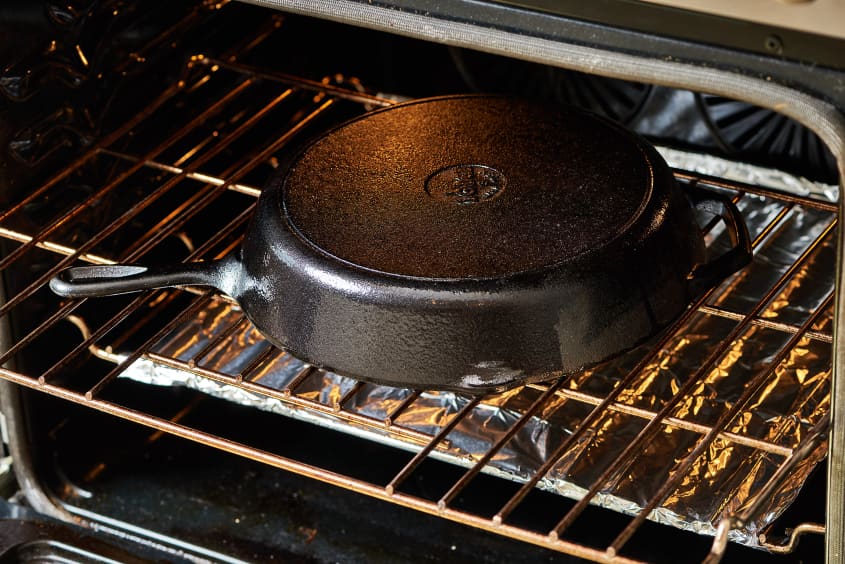
5. Place the skillet upside down on the oven's center rack.
6. Place a sheet of aluminum foil below the rack to catch any drips.
7. Bake for an hour.
8. Turn off heat and allow to the skillet to cool completely before removing from oven.
Additional Notes: A seasoned skillet is smooth, shiny, and non-stick. You'll know it's time to re-season if food sticks to the surface or if the skillet appears dull or rusted.
Tomorrow, we'll look at how to clean cast iron.
Want more smart tutorials for getting things done around the home?
See all of our Home Hacks tutorials

We're looking for great examples of your own household intelligence too!
Submit your own Home Hacks tutorial or idea here!
(Images: Emily Ho)


Monterey Pitcher fr...

I always believed you were not supposed to use soap on a cast iron skillet. Wouldn't hot water and a wire brush be enough?
You don't want to use soap on a seasoned skillet.
" (Cast iron should not normally be washed with soap, but it's fine here since the pan is about to be seasoned.)"
Can this technique be used on a used skillet? I've seen a couple in a neighborhood antique shop and am considering buying one. But have been leery (leary?) thus far by not wanting someone else's "seasoning". So could I buy a used one, and would this technique start me over as if it were a new skillet, or would some residual seasoning remain?
Greta, yes you can. I would get a still brush or steel wool and get as much junk off the pan as you can. Then you can re-season and it will be like new.
What is the difference between the $20 cast iron you have pictured here and one from Le Creseut for example? Do they cook the same?
Thank you for this timely post:
How would I go about seasoning a reversible cast iron griddle/grill? Same as above? Or do I need to do it once for each side?
Said griddle/grill has been sitting on my stovetop for a week - I have been afraid to use it, even though it is preseasoned. (I have read that preseasoned does not always mean seasoned.)
ciaoamy, they are the same if you are talking about the le crueset with the black iron interior. They have some pans that are enameled on the inside, and that is a different product.
The only difference otherwise is the prettier exterior and the 10x price
Sousani : It'd be exactly the same. If you read the instructions carefully, they say to coat both the inside and outside of the skillet with oil/shortening.
Same goes for your two-sided piece - grease both sides up and toss it in the oven.
GretaGrace : Yes. Scrub off the old and re-season to your heart's content. A well-intentioned person did this for me when I brought a skillet full of cornbread to a party once. I got back a shiny-clean pan with all of the season brillo-padded off of it. Back to square one with a pack of bacon the next Saturday.
A helpful note on the seasoning material: go with the shortening - it's got a MUCH higher smoke-point than standard vegetable oil and that's going to be key to a happy life with your pan.
Also: a good season isn't made in an hour. It's something that builds up over time as you use the pan. Most "how to use cast iron" guides suggest you give the pan a quick wipe-down with oil after you've used it and cleaned it out. Don't forget the bottom of the pan - that's a prime spot for rust spots when friction from the burners wears off the initial seasoning.
I second the use of shortening vs. vegetable oil for seasoning. On occasion, when I've used oil to season pans, I've ended up with a sticky coating, not so with shortening. Also, plan on cooking bacon in new/newly seasoned pans and just wash gently with water or just wipe out any residue after use and heat gently to dry. The high fat content in the bacon prevents sticking and helps season the pan further. Ahh bacon...
So the "upside down" part does not matter? One go is enough to season reversable cast iron?
Yay! Thanks!
I purchased a small Lodge cast-iron skillet at the hardware store the other week. I also own an older Lodge 11-inch skillet that I have owned for years (like 18).
The 11" skillet is relatively non-stick, and the bottom finish is smooth when seasoned. The new 7-inch skillet had a rougher finish, very similar to fine sand in texture, when I bought it. I've been cooking mainly eggs with canola, and just doing a wipe-up with a paper towel (we can compost "food stained" paper towels). It is still sticking more than the older skillet with eggs, which is a primary use for my skillets.
Should I take extraordinary measures and grind/sand down the little skillet to give it a smoother surface, or is it something that will come with use? I accidentally placed the old skillet on a high burner earlier this year and while I burnt-off the old seasoning (to white ash--it wasn't pretty) it only took 3 weeks to get a nice smooth black finish leading me to think it was smoother to begin with. Thanks to all for your opinions.
I love the idea of cast iron but am seriously worried by the idea of just wiping it out without soap after using it. What's to prevent bacteria, germs, E. coli, whatever from multiplying on the surface and tainting whatever gets cooked next?
I have a cast iron skillet that I didn't really take proper care of. I would rinse it out with water after and wipe it with oil, but I do need to season it properly. It came pre-seasoned but I didn't know about re-seasoning agai. Right now it has almost a grey look to it. Hopefully I can get it seasoned right.
Thanks for the response. I've been eying this one for years and it's finally on sale. http://www.williams-sonoma.com/products/le-creuset-12-inch-fry-pan/?pkey=ccookware-le-creuset|ckwlcebst Decisions decisions...
ciaoamy : That's enameled. "[E]asy-clean non-reactive interior does not require seasoning" and "Use wood, plastic or heat-resistant nylon tools to avoid scratching the enamel surface" suggest to me that the Le Creuset pan there is coated inside and not just straight-up cast iron. Fine if you like that sort of thing, but then you don't get the fun of seasoning.
Also:
(a) I personally think that Le Creuset's a funny joke played by the French on pretentious American "foodies". NFW would I spend $140 on a cast iron pan.
(b) Have you looked at the Lodge enameled cast-iron skillets?
Carson : I usually give mine a scrub with kosher salt to clean it (scrub it around with a stiff brush). Salt's very good at being anti-bacterial.
...the fact that you heat a pan up to hundreds of degrees before you use it kind of helps with keeping the little critters down, too.
I don't use my cast iron skillet very often (maybe once a month), but I ALWAYS use soap and a scrubber to clean it after use. It's also relatively new, so I've only used it maybe 10 times. But after washing and [immediately] drying, I coat with cooking spray and wipe down with a paper towel. I actually store it in the oven, so maybe for me, it eliminates the above suggestion of baking for an hour. The more and more I've used it, it's become successfully non-stick and shiny.
for anyone considering a cast iron skillet or dutch oven, by all means get one!! my lodge cast iron dutch oven is my favorite kitchen item and probably the most used one as well. sure i once wished for a fancy le crueset pot with a pretty color on the outside, but then i realized that the lodge ones were so much better. I know I will use it for decades and could pass it on to my offspring. I love it!
Thanks for the reseasoning tips.. I need to reseason my smaller skillet this weekend.
If you have one available, I'd suggest seasoning on a BBQ or Grill. A Gas BBQ will let you control the heat accurately enough for this purpose, and all the smoke will be outside instead of in your house. Alton did an episode on it, that's where I got the idea.
I got a lodge pre-seasoned pan for chirstmas, and went to try the use-it seasoning route at first, cooking up lots of bacon. To my surprise, the first bacon i cooked in it stuck to the pan. I decided to re-season it myself, and after some research went with the shortening seasoning on the BBQ, at a higher temp of about 350-400. I did about 3-4 coatings of shortening over about 4 hrs one day, then did it again for another 3 coats, one an hr another day. It's as shinny and black as can be. FYI, if you want to get the seasoning off of a pan, try Barkeepers Helper. stripped it down to grey iron in no time.
Lucky! I just scored a cast iron takoyaki pan today (for $10!), so this post was very timely. Thanks.
Pulse: I know it is late in the thread, but did your pan have a smooth surface to start with? Or was it a result of the seasoning? Thanks.
Most of my cast iron came from my mother and is now about 50-60 years old.
There's nothing like it, and with reasonable care it is very easy to maintain.
See my comments under the more recent post about cleaning...
Most important technique for preserving the seasoned pan: heat the pan first then add the fat before cooking.
So I have a cast iron skillet I'd never really used much, never seasoned it, etc. So 2 nights ago I went through this whole seasoning post and all went well.
Only weird thing was the pan was a little sticky in places - too much oil maybe?
Then last night I decide to make some grilled cheese. (Stove on a little higher than medium heat.) After about 2 minutes of the buttered bread being on the pan, the backs were BLACK. Like they were burned, but they'd barely been on the stove....
What did I do wrong??? I'm a little scared to use the pan for anything again since it just destroyed that bread....
What a timely article. My mom and dad just gave me an old Lodge pan they've had for about 20 years. It's probably been sitting in storage for at least a decade. It was covered in stale-smelling oily grime, but thankfully only a tiny patch of rust on the bottom.
Following the advice I read elsewhere, I'm going to scrub it out, stick it in the oven during the self-cleaning cycle to get the pan totally clean, and then begin reseasoning the pan from scratch. Does that sound like a reasonable thing to do? I don't want to wreck it!
A lot of people say that a good way to season a pan is by cooking bacon in it. While that may be true, for me it's a lot of fat, though I love bacon as much as the next guy.
The best way I've found is searing a steak. A good method can be found here:
http://www.wikihow.com/Pan-Sear-a-Steak
You'll get a tasty steak, and I've found it does a great job in seasoning at least the bottom of the pan. You'll still need to use shortening/oven methods if you want to get the whole thing, but the steak sear will do a good job in covering up scratches.
Seasoning only works if you're pan is in good condition. For those wonderful hand-me-downs or antique store finds, check out this guy's blog:
http://blackirondude.blogspot.com/2009/01/easy-cast-iron-skillet-reconditioning.html
I was able to save my grandmother's cast iron Wagners and Griswolds after MULTIPLE failed attempts as seasoning them. They needed to be reconditioned first!
Good News!!
No need to scrub and salt and scrape and worry about other people's gook on your used cast iron skillets!
All you have to do it pop the cast iron into a self-cleaning oven, and turn it on! Once the self-cleaning cycle is over, the cast iron will be spotless. all the old blackness will be entirely gone. Now it's ready for you reseason it!
I am 80 years old and I have been using cast Iron all of my life. I have collected it over the years from yard sales, thrift stores etc. and have an extensive collection. I am surprised that no one ever tells how to clean a skillet or other utensil of the built up baked on grease that accumulates. The person who suggested putting it in the self cleaning oven has the right idea but not all of us have the self cleaning oven. I have used the following method in camp fires and also in my fireplace. Simply place the utensil in the flames and keep an eye on it, turning it as the build up burns off. it will soon be as clean as a new one. Then season it as suggested. I also routinely wash my cast iron when washing dishes. I have also put it in the dish washer. I make sure it is dry and then give it a quick wipe with some shortening. If I think there is a danger of food sticking, I give it a shot of pan spray.
thank you because I got 3 cast iron pans for cheap and I dont want to ruin them